Personalization provides the right content to the right audience.
What does it mean? – For example, you are a customer of http://www.myGrocceryShop.com and usually, you buy vegetables and fruits online. Maybe you are not aware, but the grocery shop already know your behavior. Next time in the main page of the website you will see a bunch of fresh vegetables instead of meat or potato chips. You will see more targeted offers personalized for you.
Another example, you are going to your 3-years old nephew’s birthday. You opened http://www.myTownToysStore.com and bought let’s say a toy car. Two years later you opened the same website and got offered toys for ~5-years old boys.
Both examples demonstrates that stores try to understand your interests, show the right content even over a long time and lead you to some goal you might be interested in, this is called engagement.
Hence there could be questions like:
- How technically it works?
- What if I’m not registered user but still notice personalization?
- I even open a website in a private tab but still can see my preference, is it a coincidence?
- How to build such a website?
As you can see, personalization works in a win-win strategy for client and business. Customers got what they need faster and business is able to catch clients showing the best match.
There are many companies in the market that has personalization with one or another scope of features, but I’m experienced with Sitecore, hence I’ll describe how it works in this system.
So, basically there are 2 approaches with personalization:
- Semi-Manual.
- Automated with ML (Machine Learning).
Semi-Manual
The Semi-Manual approach is based on the rules, it means that marketer is able to create a few or many different variants with specific rules like: day = weekday/weekend, time = morning/evening/etc., device = PC/iPhone/Android/Specific device/etc., location = based on country/town/area, etc. There are plenty of other rules which can be combined in different ways. Examples:
- Not authorised user from New-York who use iPad OR iPhone AND spend more then 5 minutes time on a website.
- Not authorised user who use PC AND registered via promotion form.
- Not authorised user who previously visited the website.
- Authorised user from any Europe country who searched ‘keyboard’ OR ‘mouse’ during weekend.
- Authorised user from Malaysia OR Singapore OR South Korea with age 25+.
- Any authorised user who already purchased goods.
- Authorised user from Australia OR USA who purchased ANY laptop AND day is Friday.
- Any user who bought goods in bakery category.
- Etc.
It is possible to create plenty of page variants, as it was exampled before and show one or another ‘https://somewebsite/goods‘ page depends on which rules are matched. If there are no rules to match then a default page is displayed.
Note: it’s not necessary to make a totally new page for one or another audience. There is an additional concept named “Component test”, which is like a part of a page, it can be just a different picture, text, form, any other HTML.
Beside the rules, there can be even more complex scenarios with additional approaches as content test strategies.
Why strategies and what is it, the rules aren’t enough? – No, because marketers just can assume it is a good variant provided for customers or not. Let’s say we own an airline company and want to engage customers for action buy ticket.
We have an assumption that young generation will be engaged with adventures picture like some exotic turtle underwater and for the older generation to show another experience like airplane’s business class with comfortable seats. But what if the guess is wrong and the marketers should use rules vice versa or need an additional content experience? What if there is not that obvious scenario, how to know what to show to which audience? Hence we can talk more about content test strategies.
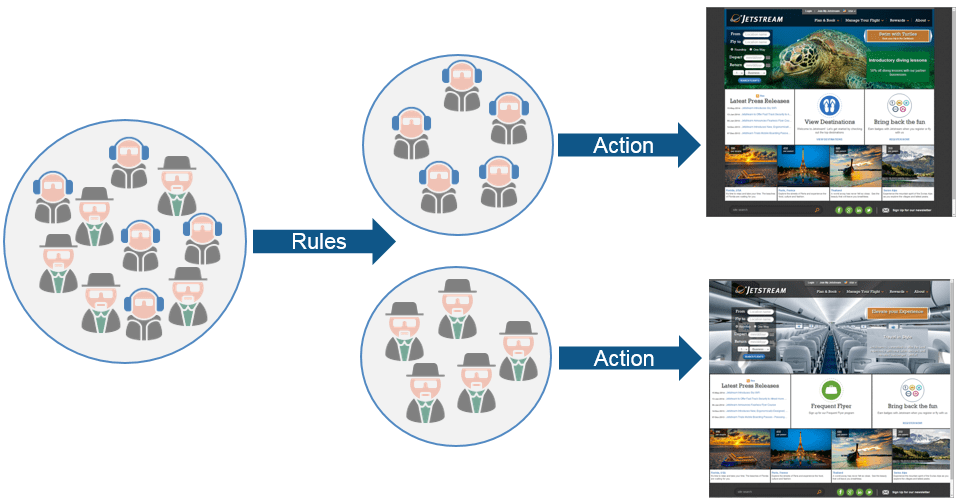
Content test strategies help to show all the variants for each audience in one of the special way:
- Random test strategy – this means a visitor might receive different experiences if they visit the site multiple times.
- Sticky test strategy – visitors will have randomly selected experience the first time, but then the visitor receives the same experience on subsequent visits.
- Round robin test strategy – presents an equal number of visitors sees each variant.

- Please find more about strategies here.
To summarise, at first we do test content variations, then study report and pick a winner experience. Therefore the system needs time to gather enough amount of visits, more visits => better result.
Automated with Machine Learning
Approach with machine learning brings new opportunities. As you can understand, there are lots of data, hundred thousands visits leaves a lot of valuable information and behavior patterns from users in the database. At the same time, the big data increase the complexity of finding the best experience for target audience. But machine learning is able to find the new patterns which weren’t possible to identify manually.
Let’s continue with the airline company example. ML can found new patterns like:
- Senior people from West Europe buy tickets mostly on weekend to Spain and Italy.
- Senior people from East Europe buy tickets mostly on weekdays to Italy.
- Adults with iPhones buy tickets at last minute => marketers can show insurance form for a special price to this audience.
Overall ML approach is able to find hidden audiences and increase value of each system.

 Ivan's Blog