Another name of the n-Tier is Multitier. Tiers often refer to components that are on different physical machines. The number of tiers varies quite a bit, 3- and 4-tier architectures are quite common, but any number is possible. So this architecture is called n-Tier or a Multitier.
The relationship between 2-Tiers in an n-Tier architecture is often a client/server relationship. The server side provides services. This could be storing information in a database, performing computation tasks, any sort of service. The client-side requests these services through messages. The communication between the two sides is called Request-Response. A tier can act as both a server and a client, simultaneously fulfilling the requests of its clients and making requests of its servers.
2-Tier Architecture (Client Tier and Data Tier):
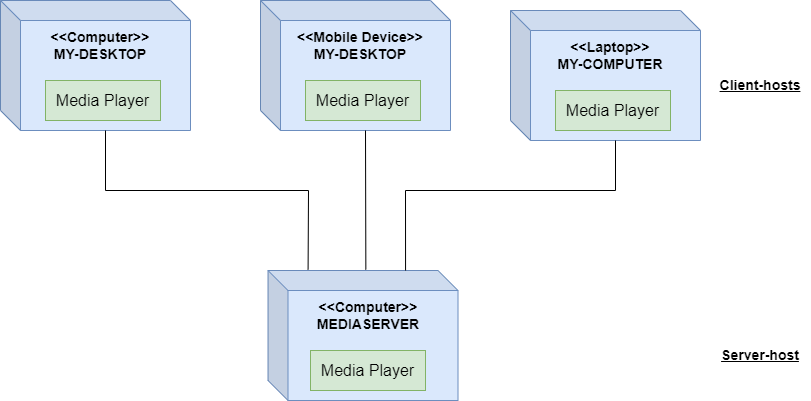
The Request-Response relationship between a client and a server can be synchronous or asynchronous.
For a synchronous request and response, the client sends a request, then awaits the server’s response before continuing execution. So a synchronous message may cause the client to hang while waiting for a response (in sequence diagram has a solid arrow).
You may get better responsiveness from an asynchronous message. In this case, the client sends a request, but control returns right away so it can continue its processing on another need. None of this processing can depend on the response from the server. Once the server has fulfilled the request, it will send a message to the client, which will have a handler that processes the response (in sequence diagram has a line arrowhead).

Improvement of the 2-Tier architecture:

The new Tier may have many names like a middle layer, a business layer, an application layer. One of the principle roles of this middle tier is to determine how or when data can be changed and in what ways. By moving this application logic and the data access logic to the middle layer, the client application software is now thinner. This client software makes request to the application tier, which in turn makes data calls. The client software is now mainly concerned with presentation, so it’s easier to maintain.
Like in any system, developers have many reasons for building more layers of abstraction into the end-tier architecture, often based on separation of concerns. The purpose of these additional tiers is very specific to the system. In the database example above, the application logic could be split into security concerns and database operation concerns.
There are a few drawbacks to the n-Tier architecture. It demands extra resources to manage the client/server relationships. Adding more tiers means there are more machines or processes to manage. With different communication protocols between machines, this additional heterogeneity and complexity makes the system more difficult to change or maintain.
One of the principle advantages of the 2-Tier client/server architecture is it is very scalable. As long as the server can handle all the requests it receives in a reasonable time, more clients can be added and start making requests. By extending this further with an N-Tier architecture, with more tiers, the scalability is incredible.
Adding tiers to the client/server relationship can allow you to apply separation of concerns. A middle layer can take the role of managing application logic in accessing the database directly.

 Ivan's Blog